
Why Europe’s Affordable Housing Act Won’t Make Housing More Affordable

Main takeaways
- Housing affordability is a real problem in certain parts of Europe. But curbing short-term rentals – barely 1% of EU homes – will not solve the supply shortage.
- The Commission risks legislating before the EU’s new data regime has produced meaningful evidence, putting politics ahead of its own ‘evaluate-first’ principle
- In cities that have imposed strict curbs, both rents and hotel prices actually went up. Europe should not repeat this mistake that has already failed locally.
Parts of Europe face a housing crisis, and the European Commission wants to act. But there is a problem: building homes, urban planning, and social housing are the responsibility of national, regional, and local governments. Housing is, for the most part, simply not an EU competence. To its credit, the Commission’s wider plan reflects this, most of its 10 actions address the real drivers: supply, investment, and vacant homes. The forthcoming Affordable Housing Act is the exception, targeting short-term rental (STR) services instead.
STRs sit at the intersection of housing and the Single Market, squarely within the Commission’s remit. That may explain why the Housing Act, now brought forward to early July, focuses on this sliver of the market: it is the only part Brussels can touch.
What’s at stake? The Commission says the Act will help authorities designate areas under housing stress and restrict short-term rentals within them. The range of measures under discussion is broad: caps on nights let per year, seasonal limits, prior authorisation for tourist use, restrictions on second homes, all the way to outright bans. Brussels frames this as a proportionality test to keep local measures within EU law. The risk is the opposite: a test that legitimises restrictions, rather than disciplines them.
1. Commission’s own figures do not justify targeting short-term rentals
STRs account for only a small part of the EU housing market: just 1.2% of total dwellings according to the Joint Research Centre (JRC), the Commission’s in-house research arm. Even in rural Europe, where their prevalence is highest, the figure reaches just 1.5%. Less than 1% of the EU’s housing stock is classified as ‘intensive’ short-term rental.
For each entire-home STR listing, the JRC counts roughly 15 dwellings that are not used as a primary residence. This includes vacant homes, holiday homes, or properties used only occasionally. Fifteen to one. And yet the legislative spotlight falls on the one.
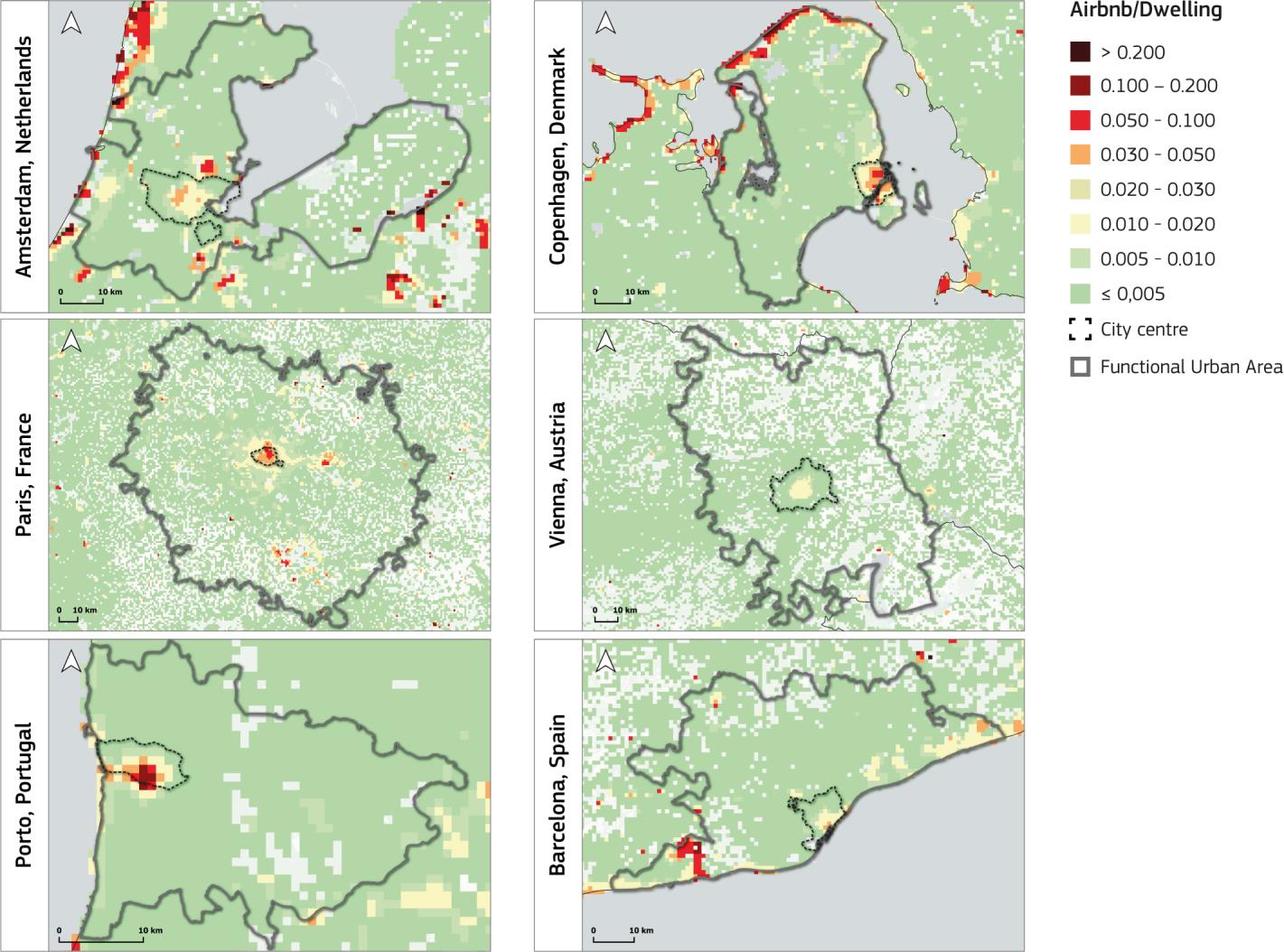
The geographic picture is equally revealing. JRC mapping shows that high-density STR clusters are concentrated in touristic neighbourhoods as small as two square kilometres in cities such as Paris and Barcelona. Across the wider metropolitan areas, STRs account for 2.2% of dwellings in Paris, 1.1% in Barcelona, 1.0% in Madrid, and 0.4% in Berlin. The highest shares, between 7% and 9% of the housing market, are found in destinations such as Zadar, Split, and Cannes-Antibes, whose economies largely depend on tourism, rather than being sprawling capitals that face affordability crises.
Figure 4 – Share of entire property Airbnb listings in relation to the total number of dwellings per 1k areas in selected EU cities
2. The empty homes nobody wants to talk about
The most uncomfortable number for anyone serious about addressing housing affordability is the vacancy rate. The Commission’s own plan puts it close to 20% across the EU and identifies ‘constrained supply’ as the core driver. In several cities that are currently restricting STRs, between 10% and 30% of the housing stock just sits empty. Set either figure against the 1.2% share for STRs, and the obvious question is why the Commission is trying to regulate the smaller number. Presumably, legislating on Airbnb, HomeToGo, and similar platforms is politically easy, while reforming construction permits, repurposing vacant office buildings, or unlocking blocked supply are slow and politically painful.
It also amounts to a quiet abandonment of the Commission’s own better regulation principles. A separate law on short-term rentals, the Data Collection and Sharing on Short-Term Rentals Regulation, just entered into force last month and is meant to produce harmonised STR data across all 27 Member States for the first time. With implementation still at a very early stage, the sensible course would be to wait until enough harmonised data has been collected before pressing ahead with the Housing Act. Instead, the Commission has chosen to legislate before the evidence is in, creating rules for a problem that has yet to be properly identified or measured.
3. Lisbon and Edinburgh offer cautionary tales
The next question is whether STR restrictions actually work. Take Lisbon. The city introduced strict STR rules in 2019, but then lifted its citywide moratorium on new STR licences in 2025 after the data came in: rent growth had accelerated during the restriction period, from 5.7% to 9.2%. At the same time, hotel prices rose 30% in the years following the restrictions, making the city less affordable for visitors as well as residents.
Edinburgh’s licensing regime followed a similar pattern: rents and hotel prices rose at roughly twice the rate seen in the rest of Scotland, Fringe Festival visitor numbers fell, and local authorities have admitted they hold no evidence that the policy improved housing supply or affordability. These are the real-world results of treating STRs as the cause of a crisis they are too small to have caused. An EU framework that legitimises this approach risks exporting failure across the Single Market.
Conclusion: A different proposition
None of this is to argue that STRs should be a regulatory free-for-all. There is a version of this initiative the EU could actually pursue that would make a difference on the ground. Where STRs are densely concentrated and demonstrably displacing residents, narrow neighbourhood-level rules are entirely defensible, especially when backed by the kind of granular evidence the JRC can now produce.
A useful Affordable Housing Act would establish strong, binding guardrails against disproportionate STR rules. It would provide a workable methodology for calibrating restrictions to the few square kilometres where STR density is genuinely material, while ensuring basic due process for hosts. Yet, this is far from how the EU typically legislates. More often than not, the reflex is to impose prescriptive rules with abstract application, while paying little attention to how they translate into enforcement on the ground.
If the Commission is serious about affordable housing, it must tackle vacancy rates of up to 30%, construction backlogs, and planning paralysis.